When most people search for ways to make money with ChatGPT, they usually find the same recycled advice, fake income screenshots, and unrealistic AI business ideas. That’s exactly why I decided to test this side hustle more seriously and understand what actually happens when a student tries to use ChatGPT and Canva for real client work.
In my previous article on the best AI tools to make money online in India, I explained how you can use ChatGPT and Canva to create pamphlets, banners, thumbnails, and promotional creatives for local businesses. I also shared real projects, outreach methods, and explained how I started getting small client work through institutions and local contacts.
But after publishing that article, I realized most people still had much bigger questions in their minds.
People wanted to know:
- Is this actually sustainable?
- Can beginners realistically get clients?
- Is this another overhyped AI side hustle?
- How difficult is local client work?
- Can ChatGPT actually help in real projects?
So instead of writing another theoretical guide on how to make money with ChatGPT, I decided to study this business model more closely for 7 days and document the real experience behind it.
And honestly, this experiment taught me something very important.
Most people trying to make money with ChatGPT focus too much on the AI tool itself and completely ignore the business side.
The real challenge is not generating ideas.
The real challenge is:
- getting clients
- building trust
- understanding demand
- improving communication
- and delivering work consistently
That’s the reality most fake AI influencers never talk about.
At the same time, I also realized this is one of the most practical forms of AI freelancing for beginners in India right now.
Not because ChatGPT magically prints money.
But it helps you complete real client work much faster, which is why many beginners are now trying to make money with ChatGPT.
Why I Decided to Test This ChatGPT Side Hustle Properly
After completing around 8–10 small projects and working with two institutions, I started noticing a major difference between YouTube advice and real-world execution.
Most online creators make AI freelancing look extremely smooth.
They show:
- fake dashboards
- unrealistic earnings
- luxury lifestyle thumbnails
- “AI agency” screenshots
- passive income claims
But almost nobody talks about:
- How difficult client acquisition actually is
- Why repeat clients matter more than one-time projects
- How seasonal this work can become
- Why local connections are important
- Or how ChatGPT sometimes gives terrible outputs initially
That’s exactly why I wanted to test this model more seriously. Not to prove that you can become rich overnight.
But to understand whether beginners can realistically make money with ChatGPT and Canva by offering simple freelancing services to local businesses.
And after observing this closely, I can confidently say this: This model actually works.
But it works very differently from how social media presents it.
The Biggest Thing I Learned — AI Alone Does Not Make Money
One of the biggest misconceptions among beginners is the belief that AI tools automatically generate income.
That’s completely false.
Businesses do not care whether you used ChatGPT, Canva, Photoshop, or any other software behind the scenes because they only care about results.
They only care about results.
For example, if a coaching institute needs:
- admission pamphlets
- event banners
- sports creatives
- scholarship posters
- social media promotions
They simply want someone who can create decent-looking work quickly and affordably.
That’s where tools like ChatGPT become genuinely useful for beginners trying to start AI freelancing work.
Instead of spending hours thinking about headlines, promotional lines, layouts, or content structure, ChatGPT helps speed up brainstorming significantly.
Then Canva helps convert those ideas into actual deliverables. That combination is powerful because it helps you complete client work much faster and more efficiently.
This is also where many beginners slowly start understanding how to make money with ChatGPT in practical ways instead of chasing unrealistic AI shortcuts online.
But the important thing is this: ChatGPT helps you execute faster.
It does not replace:
- communication
- creativity
- consistency
- client handling skills
That’s a very important difference that most AI side hustle videos completely fail to explain.
Why Local Businesses Are a Better Opportunity Than Fiverr for Beginners
One thing I realized during this experiment is that beginners often make things much harder for themselves by immediately trying to compete on platforms like Fiverr or Upwork.
The competition there is already massive, especially for beginners trying to make money with Canva and ChatGPT services.
Thousands of people are offering:
- logo design
- thumbnails
- Canva services
- banner design
- AI writing
- social media creatives
And most beginners don’t even have a portfolio initially.
That’s why I personally found local businesses much more practical for AI freelancing beginners.
For example, if you regularly go to a gym, you can approach them and say:
“We can create membership banners, offer creatives, and promotional posts whenever needed.”
Similarly:
- Institutions need admission pamphlets
- Restaurants need discount banners
- Coaching centers need event creatives
- Schools need annual function posters
Most small businesses already need these services.
In many cases, local businesses prefer affordable and fast creatives over expensive agency work.
The problem is that many beginners never approach them.
And honestly, getting clients is probably the hardest part of this entire ChatGPT side hustle.
How I Actually Used ChatGPT During Client Work
One thing I quickly realized while trying to make money with ChatGPT is that the AI rarely gives perfect output on the first attempt.
This is something most YouTube tutorials never explain properly.
People online make it look like you type one magical prompt and instantly get professional client work ready for delivery.
That rarely happens in reality.
In many cases, ChatGPT actually overcomplicates things.
Sometimes the copy becomes:
- too dramatic
- too salesy
- repetitive
- unrealistic
- Or simply unnatural for local businesses
For example, coaching institutes usually want simple and clear messaging because parents and students should immediately understand:
- courses
- batches
- admission details
- offers
- contact information
But ChatGPT often tries to “enhance” the content too much.
That’s why prompting becomes a real skill if you seriously want to make money with ChatGPT consistently.
I often had to refine prompts multiple times by saying things like:
- Make this sound simpler
- remove unnecessary words
- Make this more professional
- shorten this headline
- Make this suitable for students
- create cleaner CTA lines
The better you communicate with ChatGPT, the better your results become.
That’s one of the biggest lessons I learned during this experiment.
Most beginners fail because they expect AI to think for them instead of using AI as a support tool.
This is an example of how I used ChatGPT to generate promotional content ideas before refining the output manually.
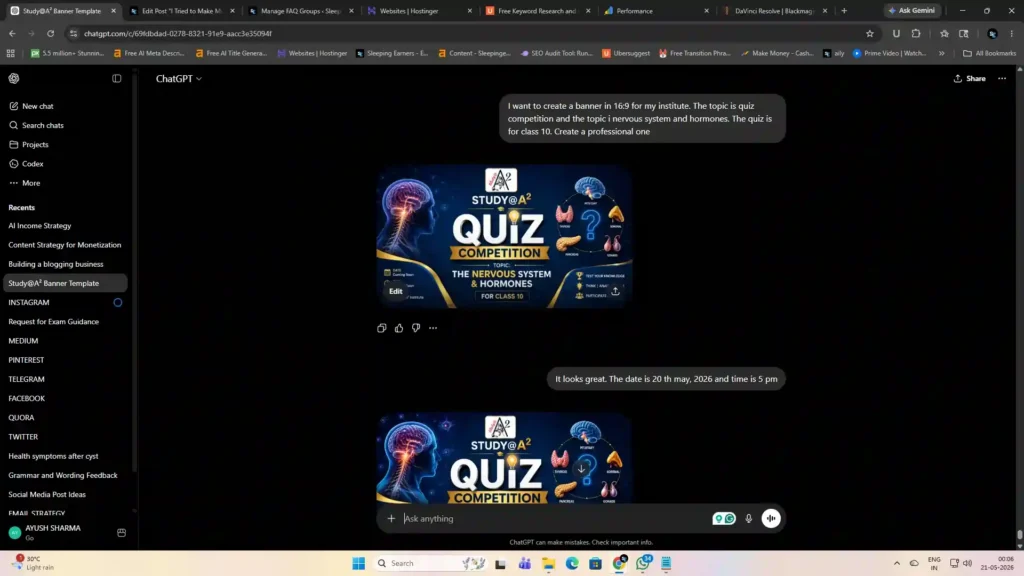
Prompting becomes a real skill once you start working with actual clients and business requirements.
How I Used Canva Free Instead of Canva Pro
Another interesting thing is that I completed all these projects using the free version of Canva.
A lot of beginners think they need expensive software before starting.
That’s not true.
For local client work, like:
- pamphlets
- banners
- social media creatives
- gym promotions
- school posters
The free version is already more than enough initially for beginners trying to make money with Canva through local client work.
I mainly used Canva for:
- template customization
- resizing formats
- adding logos
- arranging layouts
- changing colors
- improving presentation
And honestly, Canva saves an enormous amount of time.
Instead of designing everything from scratch, you can simply:
- select a template
- replace content
- adjust branding
- improve layout
That speed becomes very useful when handling multiple projects.
Most local businesses care far more about fast delivery and decent presentation than advanced graphic design perfection.
Of course, Canva Pro does make things easier with:
- premium templates
- background remover
- brand kits
- premium assets
But I genuinely believe beginners should first focus on getting clients instead of buying subscriptions immediately.
Because without clients, even the best tools become useless.
Here’s one of the actual pamphlet designs I created during this experiment using ChatGPT for content ideas and Canva for execution.
Most local businesses care far more about fast delivery and decent presentation than advanced graphic design perfection.
The Hardest Part — Getting Clients
If I had to explain the hardest part of this entire ChatGPT side hustle in one sentence, it would be this:
Getting clients is significantly harder than learning the tools.
Most beginners spend weeks learning prompts, Canva tricks, and design techniques, but never actually approach businesses.
That’s a huge mistake.
This business model only works when people know you can help them.
And honestly, local connections matter a lot.
For example:
- If you go to a gym regularly
- know teachers or coaching owners
- have friends running small businesses
- or already know local institutions
Your chances improve significantly.
That’s exactly how I got my early opportunities.
I approached places I was already familiar with instead of randomly messaging hundreds of strangers online.
And one thing I noticed is that demo work matters a lot.
Instead of simply saying:
“I can design pamphlets.”
It’s much more effective to show:
- sample admission creatives
- sports banners
- event posters
- social media graphics
People trust visuals much faster than promises.
That’s why I strongly recommend beginners create:
- 4–5 demo pamphlets
- sample banners
- fake business creatives
- promotional designs
before seriously pitching clients.
Even if the projects are fake initially, they help businesses visualize your work quality.
If you genuinely want to learn how to make money with ChatGPT, you must become comfortable approaching businesses and showing your work confidently.
Why This Work Is Highly Seasonal
One of the biggest realities I discovered during this experiment is that this business is extremely seasonal.
Some months may bring multiple projects.
Some months may bring almost nothing.
That’s why people expecting a stable monthly income immediately may get disappointed.
For example:
Strong Seasons:
- March–April → admission season
- October–April → sports tournaments
- Teacher’s Day → school creatives
- Children’s Day → event banners
- annual functions
- coaching launches
During these periods, demand increases heavily because institutions and businesses suddenly need promotional material quickly.
In fact, there’s even a possibility that you may earn several months’ worth of income during one strong season if you already have good local connections.
But outside these periods, client flow can slow down significantly.
That’s why I personally believe beginners should initially treat this AI freelancing work as:
- a side hustle
- a skill-building opportunity
- or part-time freelance work
instead of depending completely on it financially.
Why Repeat Clients Matter More Than Viral Income Screenshots
One thing social media completely ruins is people’s understanding of freelancing income.
Everyone wants:
- viral screenshots
- instant success
- massive earnings
But after testing this model more seriously, I realized repeat clients are far more important than one-time projects.
A one-time client gives temporary money.
A repeat client creates stability.
Repeat clients are what eventually turn small freelance projects into a stable side income.
For example, institutions regularly need:
- admission creatives
- result posters
- event banners
- scholarship promotions
- social media posts
Once clients trust your work, they often contact you again whenever they need new designs.
That’s where this business model becomes much stronger long-term.
The difficult part is reaching that trust level initially.
And honestly, that takes time.
How Much Can Beginners Realistically Earn?
This is probably the biggest question people ask when they search for ways to make money with ChatGPT as a beginner.
And honestly, this is also where the internet becomes extremely misleading.
You’ll see creators claiming:
- ₹1 lakh per month
- fully automated AI agencies
- passive income systems
- “Earn while sleeping” models.
But after testing this business model properly, I think beginners should keep far more realistic expectations.
If you’re just starting, your first goal should not be earning huge amounts immediately.
Your first goal should be:
- learning client communication
- understanding business needs
- improving Canva execution
- learning prompting
- building connections
- and getting repeat work
In the beginning, even earning ₹2,000–₹4,000 as a student is already a good sign because it proves people are willing to pay for your work.
That’s exactly what happened in my case.
Over time, if you:
- improve your portfolio
- build stronger connections
- Get repeat clients
- understand seasonal demand
- and become faster at execution
Then scaling becomes much easier.
But I still believe beginners should avoid unrealistic expectations initially because this field depends heavily on:
- networking
- consistency
- trust
- and visibility
Some months may bring:
- multiple projects
- event creatives
- sports banners
- admission pamphlets
while some months may bring almost nothing.
That inconsistency is something most fake AI freelancing videos completely ignore.
The Biggest Mistakes Beginners Make in This AI Side Hustle
After testing this model more seriously, I noticed beginners usually make the same mistakes repeatedly.
1. Expecting AI to Do Everything Automatically
Many people think ChatGPT magically creates perfect freelancing work instantly.
That’s completely false.
AI still needs:
- direction
- editing
- prompting
- human judgment
- and refinement
If your prompts are weak, your output will also become weak.
2. Learning Tools But Never Pitching Clients
This is probably the biggest mistake.
People spend:
- Weeks of learning Canva
- watching ChatGPT tutorials
- saving prompts
- consuming AI content
but never actually approach businesses.
No outreach means no income.
That’s the reality.
3. Trying to Target Everyone
Many beginners say:
- “I can design everything.”
That usually creates average work.
It’s much smarter to focus on:
- institutions
- gyms
- restaurants
- schools
- local businesses
and become better at that niche first.
4. Ignoring Demo Work
Businesses trust visuals much faster than words.
If you have:
- sample banners
- fake event creatives
- admission pamphlets
- sports posters
Your chances of getting replies improve significantly.
That’s why portfolio work matters even before getting real clients.
5. Depending Completely on This Initially
This is very important.
I personally believe beginners should initially treat this as:
- a side hustle
- freelance skill
- or an extra income stream
Because client flow can become inconsistent initially.
Stable income only starts appearing when:
- Repeat clients increase
- connections improve
- Referrals start happening
Final Verdict
After spending more time testing this business model, I realized something very important:
Most people searching for ways to make money with ChatGPT are actually searching for shortcuts.
That’s why fake AI gurus grow so quickly online. They sell the dream of effortless income.
But real freelancing works differently.
You need:
- practical skills
- decent communication
- consistency
- and the confidence to approach people
At the same time, I also realized that tools like ChatGPT and Canva can genuinely become powerful income tools when used correctly.
Not because AI replaces effort.
But because AI tools help you:
- think faster
- execute faster
- brainstorm faster
- and deliver work more efficiently
That’s the real opportunity.
And honestly, even if you don’t become a full-time freelancer from this, learning how to combine AI tools with real-world skills is becoming increasingly valuable.
Because the people who will benefit most from AI are not the ones chasing shortcuts.
They are the ones learning how to use AI to solve real problems better than everyone else.
The people who successfully make money with ChatGPT are usually the ones who focus on solving practical business problems instead of chasing shortcuts.
FAQ
After testing this ChatGPT side hustle more seriously for 7 days, I realized most beginners still have practical questions about getting clients, earnings, Canva, and whether it’s actually possible to make money with ChatGPT consistently. These are some of the biggest questions people usually ask before starting.
Is this ChatGPT side hustle actually worth it?
After testing this more seriously for 7 days, my answer is honestly yes—but only if you understand what this business really is.
This is not:
- passive income
- instant money
- AI automation magic
- or some shortcut to overnight success
This is client work.
And client work always requires:
- communication
- consistency
- trust
- revisions
- outreach
- and patience
At the same time, I genuinely believe this is one of the most practical ways beginners can make money with ChatGPT and Canva right now, especially for students and people who already have local connections.
The biggest advantage is that businesses already need these services. You are simply using AI tools to complete that work faster.
How much can students realistically earn from this?
Most beginners should keep realistic expectations initially.
In the beginning, even earning ₹2,000–₹4,000 as a student is already a good sign because it proves people are willing to pay for your work.
Over time, earnings can improve if you:
- get repeat clients
- improve your portfolio
- build stronger connections
- understand seasonal demand
However, this work can also become inconsistent during slow months, which is why I personally think beginners should treat it as a side hustle initially.
What type of businesses can you target?
You can target almost any local business that regularly needs promotional material.
Examples include:
- coaching institutes
- schools
- gyms
- restaurants
- salons
- tuition centers
- local shops
Institutions are usually easier because they regularly need:
- admission pamphlets
- event banners
- scholarship creatives
- social media promotions
Small shops can sometimes become harder because they may not need marketing materials regularly.
Can ChatGPT create complete client work automatically?
No, and this is something beginners should understand early.
ChatGPT can help you:
- generate ideas
- improve copy
- create headlines
- speed up brainstorming
But the output still requires human editing.
In fact, during my testing, ChatGPT sometimes overcomplicated simple promotional content and made it sound unnatural for local businesses.
That’s why prompting becomes an actual skill.
What if nobody replies to my pitch?
Honestly, that will happen many times in the beginning.
Most local businesses are already busy, and many may ignore your message initially. That doesn’t automatically mean your work is bad.
In my experience, demo work matters a lot here. Businesses are much more likely to respond when they can actually see sample pamphlets, banners, or promotional creatives instead of just reading a message saying “I am a designer.”
Getting clients is easily the hardest part of this entire ChatGPT side hustle.
Can introverts or students do this kind of work?
Yes, but you still need some level of communication.
You do not need to become an aggressive salesperson, but you must be willing to:
- message businesses
- show demo work
- explain your service
- and follow up sometimes
Even simple local connections can help a lot initially.
For students, especially, this can become a practical way to learn freelancing, communication, and client handling together.
Making money with ChatGPT is not about finding shortcuts or copying fake AI income screenshots online. It’s about combining practical skills, consistent outreach, and tools like ChatGPT and Canva to solve real problems for businesses more efficiently.

Sleeping Earners is an independent digital publishing platform founded and run by Ayush Sharma, an SEO practitioner and online monetization strategist with 6+ years of hands-on experience in Amazon KDP, keyword research, and content-driven income models.
Ayush Sharma actively experiments with self-publishing, SEO frameworks, and monetization strategies to understand what works in real conditions. The content on Sleeping Earners is built from first-hand execution, testing, and practical results, not theory or recycled advice.