Have you ever thought of earning real income just by sharing your ideas?
According to Statista, the U.S. eBook market reached $5.38 billion in 2025 and is expected to exceed $30 billion globally by 2033.
In addition, a report from WordsRated shows that digital books now account for nearly 23% of all book sales worldwide, proving how profitable this market has become for independent authors.
That means this is the best time to start your own ebook business.
The best part? You don’t need any upfront investment — just an internet connection, a laptop or phone, and some creativity.
By the end of this guide, you’ll know exactly how to earn money with eBooks — from choosing your niche to writing, designing, publishing, and promoting your first digital book successfully.
What Is an eBook and Why It’s the Easiest Digital Product to Sell
An eBook is a digital version of a printed book, distributed through the self-publishing industry, that readers can download and read on devices like smartphones, tablets, or a Kindle.
It’s lightweight, easy to distribute, and requires zero printing cost — making it one of the most profitable digital products for beginners.
eBooks sell well because they solve real problems — whether it’s fitness, finance, or personal development, people love convenient knowledge.
Pro Tip: Pick a topic you genuinely understand. Authenticity improves sales and reader trust.
How to Earn Money with eBooks — Step-by-Step Process That Works
Earning money from eBooks isn’t complicated — it just needs the right process.
Follow these 5 simple steps, and you can create, publish, and sell your ebook with the help of ChatGPT and Canva.
All screenshots you see below show the actual ChatGPT prompts and outputs I used for this guide.
Note: You can download a free PDF with all the prompts at the end of this article for easy copy-paste access.
Step 1 — Find a Profitable eBook Niche Using ChatGPT
Your niche decides whether your ebook sells or sinks.
A profitable niche = constant reader demand.
Why this matters:
- You’ll attract a focused audience.
- You’ll face less competition.
- You can position yourself as an expert faster.
Explore related digital product niches to find a strong topic that sells well for beginners
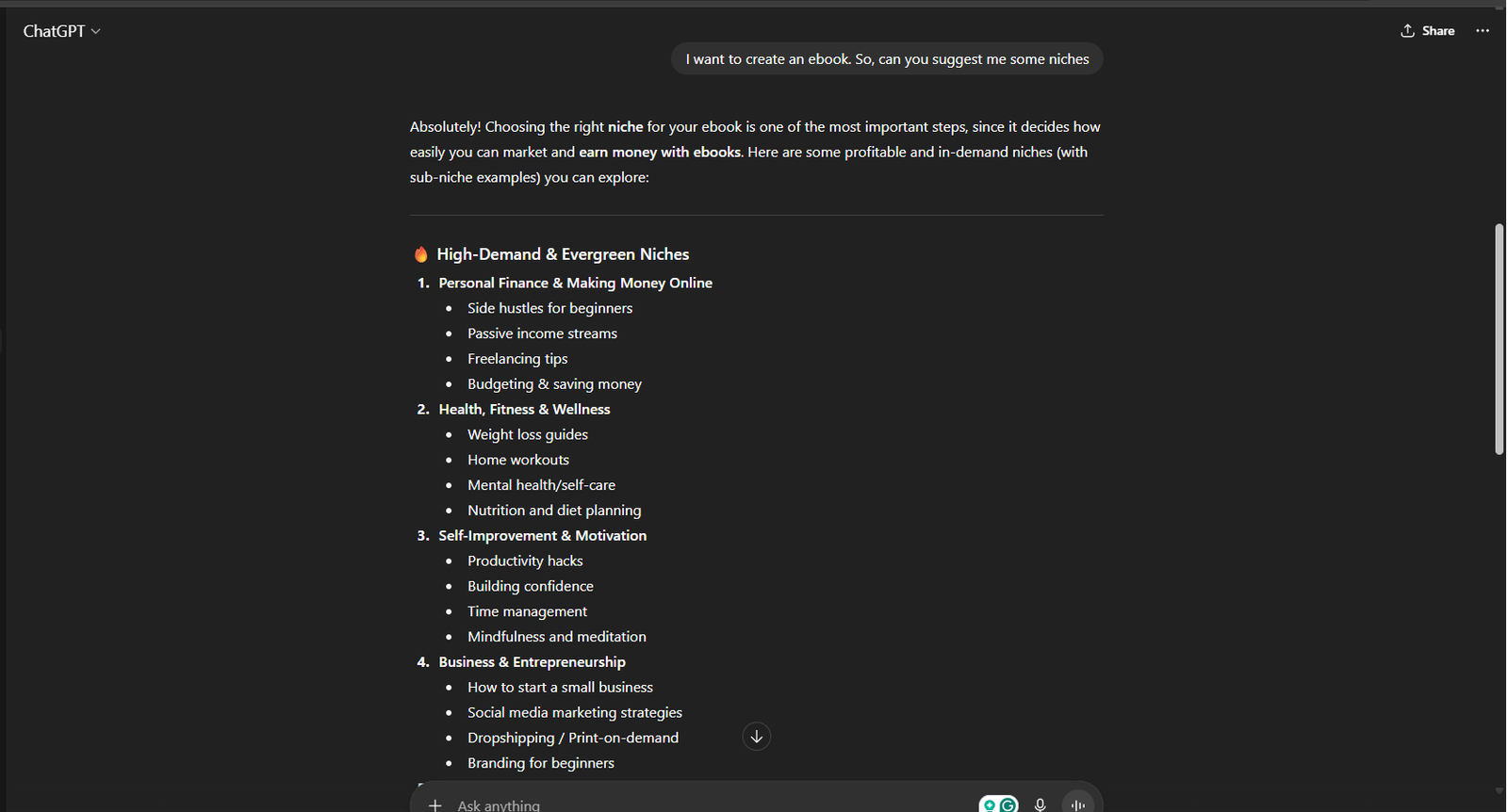
How to find a niche with the help of ChatGPT?
Type this prompt in ChatGPT = I want to create an ebook. Can you suggest some profitable niches for me to start with?
- Image 1 shows the prompt and its results.
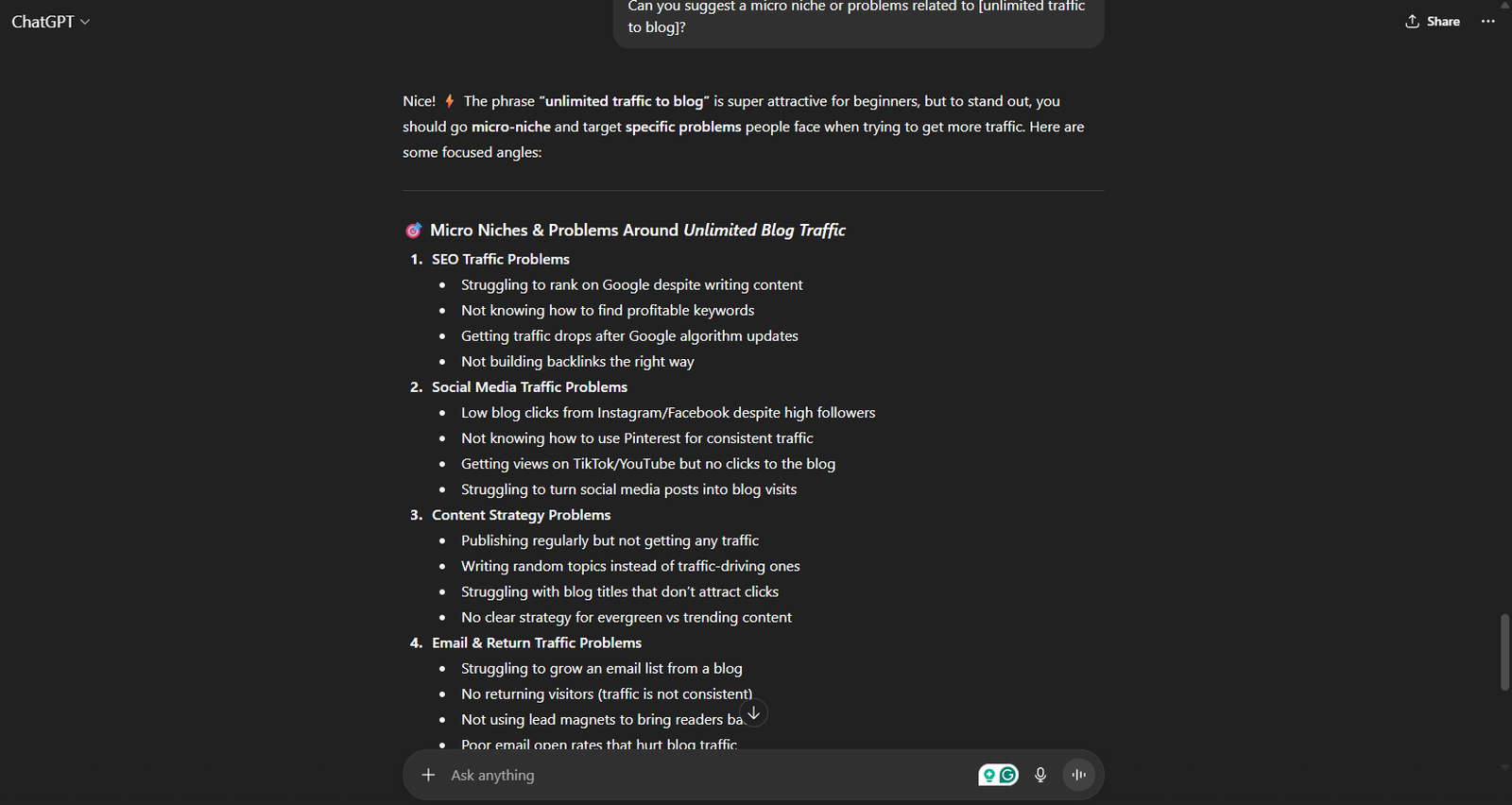
How to find a micro niche using ChatGPT?
- Type this prompt: Can you suggest a micro niche or problems related to [My Niche] that have buyer intent?
- Look at image 2 to understand better
Pro Tip: After getting ideas, search your niche keyword on Amazon Kindle or Google Trends to confirm real demand.
Tips by author: After testing 7 niches, I found personal finance and freelancing ebooks convert the best for beginners.
Pick 2–3 ideas that interest you most and save them for the next step.
Step 2 — Create a Catchy eBook Title and Subtitle
Your title is your first sales pitch.
It tells readers why they should stop scrolling and click “Buy.”
Why it’s important:
- Titles with emotional triggers sell better.
- Subtitles clarify the benefit and audience.
Use this prompt: I’m creating an ebook for [target audience] who are struggling with [specific problem]. The ebook will help them [desired outcome]. What are some catchy ebook titles and subtitles that will attract this audience?
Example: “I’m creating an ebook for beginner blog owners who are struggling to drive traffic to their website. The ebook will help them increase traffic on their website. What are some compelling ebook titles that address this problem and resonate with this audience?”
Look at images 3 & 4 to see the results of the prompt.
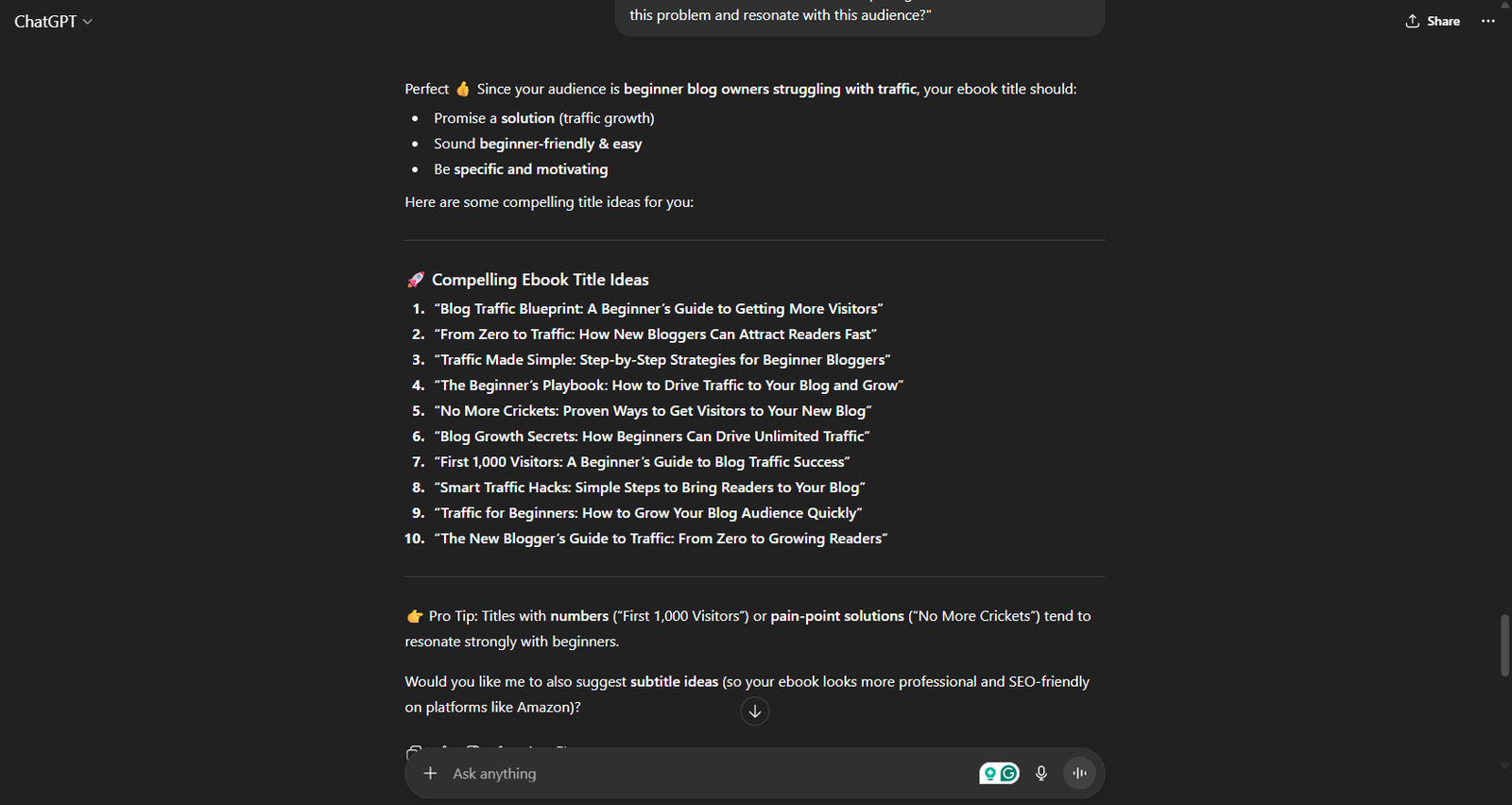
Example result from my ChatGPT prompt:
Title: From Zero to Traffic: How New Bloggers Can Attract Readers Fast.
Subtitle: A Beginner-Friendly Guide to Getting Your First 1,000 Readers Without Paid Ads.
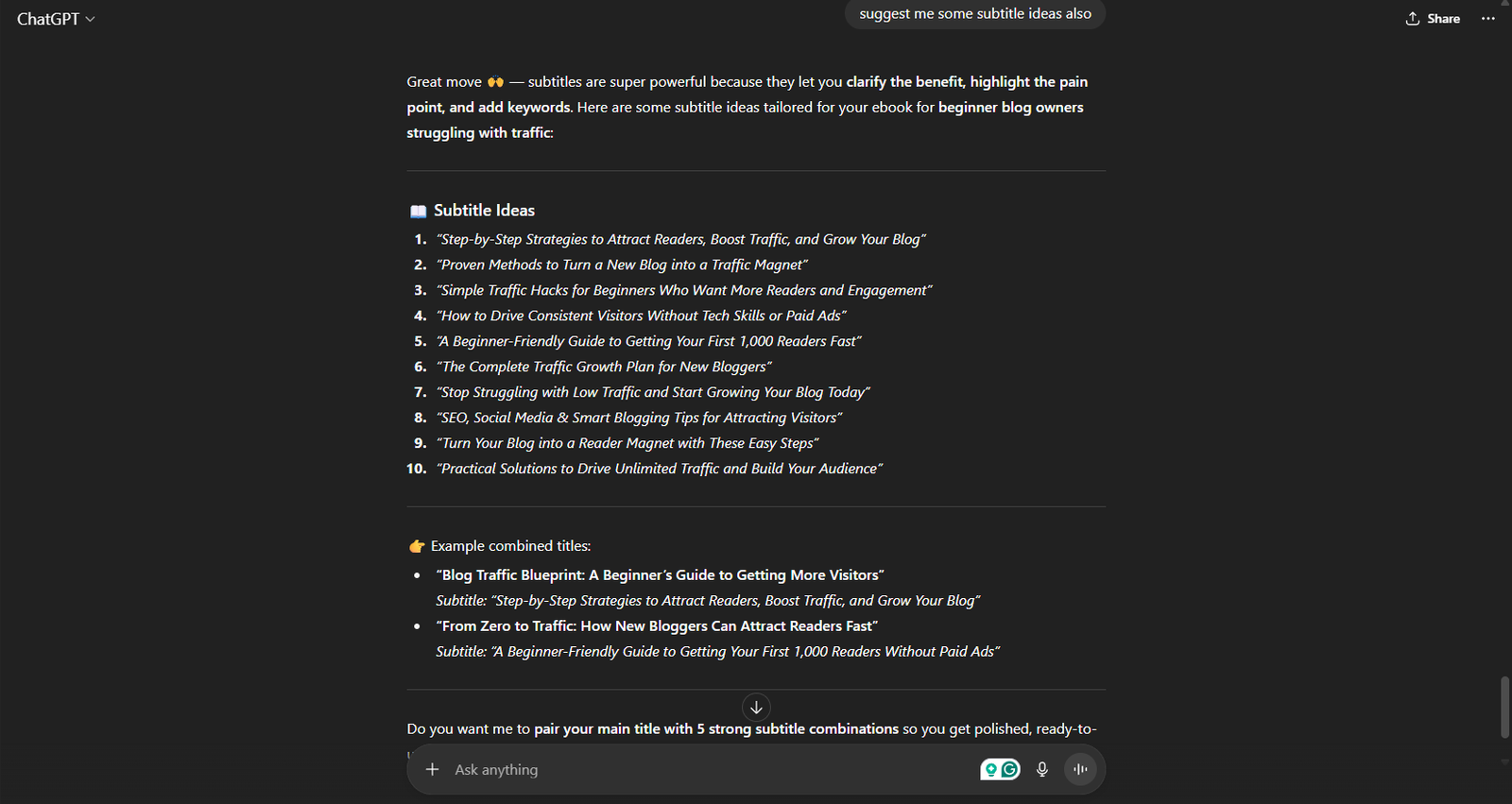
Pro Tip: Combine your top 2–3 ChatGPT title ideas. Shorter titles with action words work best.
Step 3 — Develop a Detailed eBook Outline and Structure
Now that your topic and title are ready, it’s time to give your ebook a logical structure.
A strong outline keeps readers engaged and makes writing effortless.
Use this prompt: Create a detailed outline for an ebook titled “[Ebook Title]” that covers [key topics]. The ebook should be [number] pages long and include actionable tips, real-life examples, and practical resources.
Example: “Create a detailed outline for an ebook titled ‘From Zero to Traffic: How New Bloggers Can Attract Readers Fast’ that covers keyword research, social media marketing, seo, and paid advertising. The ebook should be 40-60 pages long and include actionable tips, real-life examples, and resources for further learning.”
Look at image 5 to see the results:
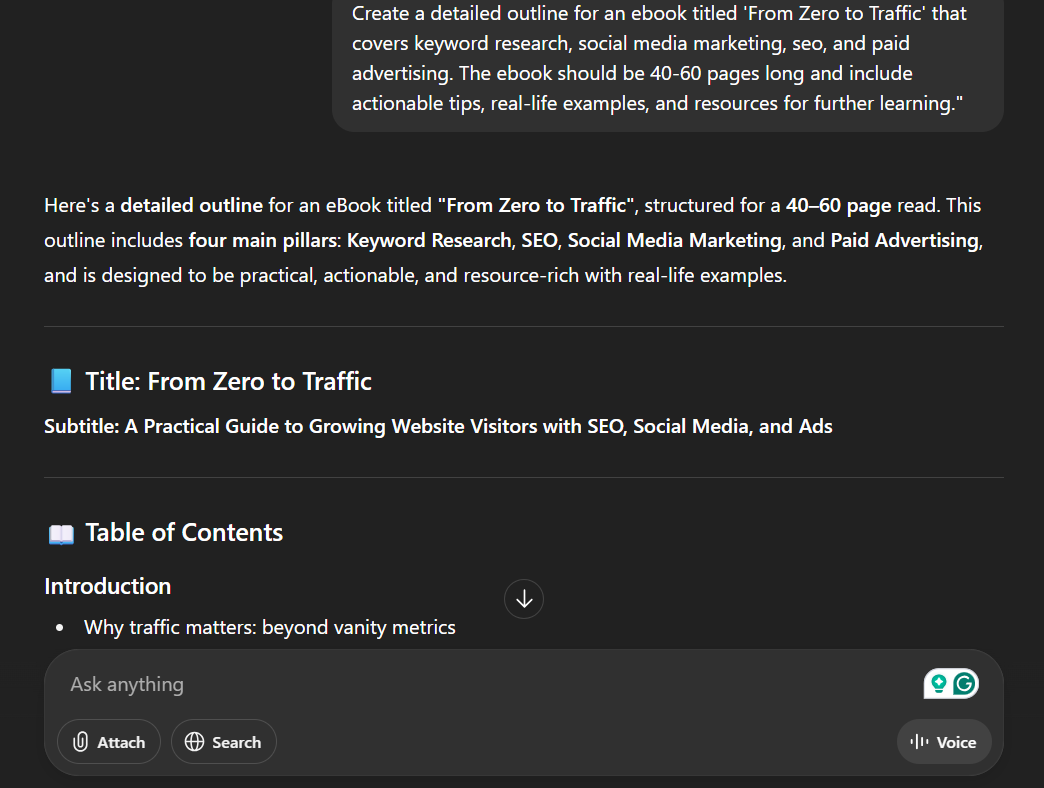
Pro Tip: Add this line to your prompt: Include case studies or success stories in each chapter. This helps build credibility and reader trust.
Copy your final outline to Google Docs — you’ll use it for writing in Step 4.
Step 4 — Generate High-Quality Content for Each Chapter Using ChatGPT
Once your outline is ready, it’s time to bring your ebook to life.
With ChatGPT, you can easily write every chapter of your ebook faster — while keeping it informative and unique.
Why this step matters:
It saves time while maintaining consistency.
You can easily edit or expand sections later.
ChatGPT helps structure your ideas clearly.
Use these prompts (copy & paste directly into ChatGPT):
- Write a chapter for the ebook “[Ebook Title]” about [specific topic]. The chapter should be [word count] words long and include real-life examples, actionable steps, and simple explanations.
- Edit and improve this ebook chapter by making it more conversational, easy to read, and suitable for beginners.
- Summarise this chapter into 3 key takeaways for readers at the end of each section.
Example: “Write a chapter for the ebook ‘From Zero to Traffic: How New Bloggers Can Attract Readers Fast‘ about understanding your audience and goals. The chapter should be 700-1000 words long and include the target audience, traffic goals (visits, leads, conversions), determining my traffic acquisition mix (organic vs. paid), and Tools to understand your audience: Google Analytics, Hotjar, Meta Audience Insights.”
Look at image 6 for the results of the prompt.
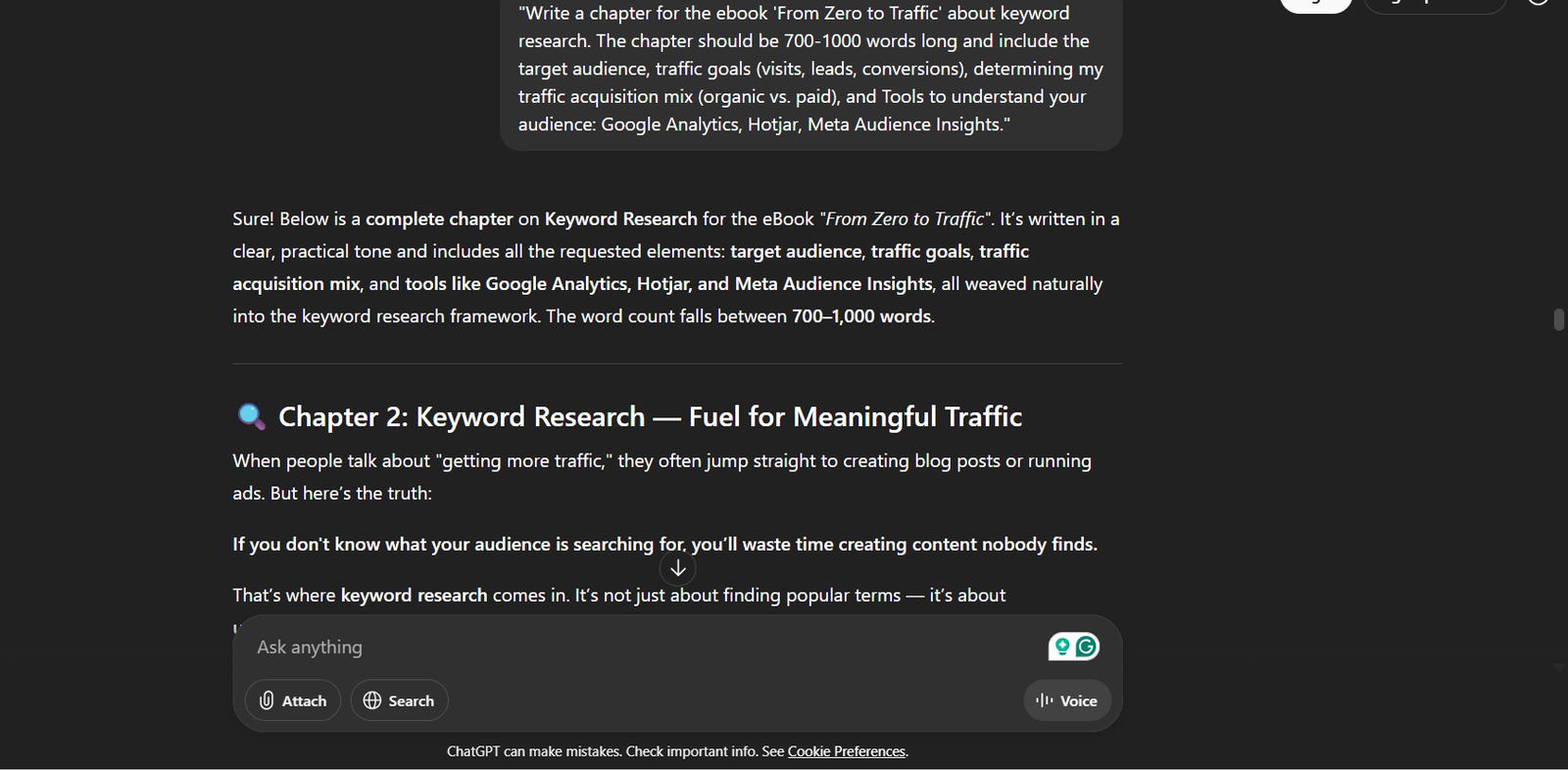
Pro Tip:
- Add your personal stories or data — this builds authority and EEAT.
- Use short paragraphs and subheadings for readability.
- Include at least one image or table in every chapter.
- The stronger your writing, the more readers buy — and the easier it is to make money selling e books long term.
Finish writing all your chapters, edit them in Google Docs, and save the final version as a clean text file for design in the next step.
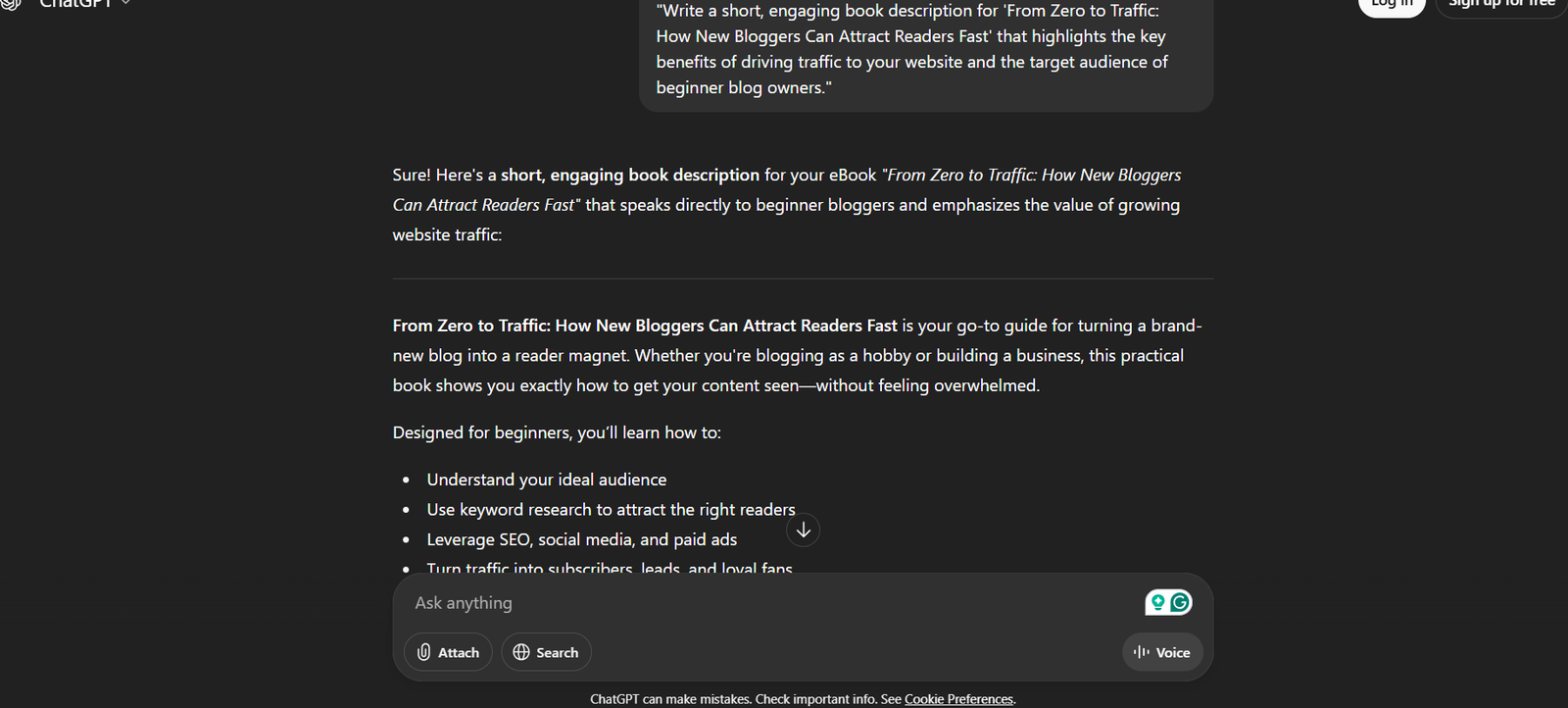
Step 5: Create a Compelling Book Description.
- Now, it’s time to let people know what your ebook is all about by creating a description for it.
- Type this prompt: “Write a short, engaging book description for ‘[Ebook Title]’ that highlights the key benefits and target audience.”
Example: “Write a short, engaging book description for ‘From Zero to Traffic: How New Bloggers Can Attract Readers Fast’ that highlights the key benefits of driving traffic to your website and the target audience of beginner blog owners.”
Look at image 7 to see the results.
Tips from Author: When I published my first eBook on KDP, I realized a descriptive subtitle increased my downloads by 40%.
Your ebook is almost ready because all the major works are done. Now, you need to design your ebook and finalise it. For that, you will need Canva.
How to design your ebook using Canva?
Follow these quick steps:
- Go to Canva.com
- Search for “ebook template.”
- Choose a layout that fits your topic and audience.
- Add your Title, Subtitle, and Author Name to the cover.
- Paste your edited content (one chapter per page).
- Insert images, icons, or infographics to break text.
- Adjust fonts and colors for readability and style consistency.
Optional ChatGPT prompts for Canva design ideas:
- Suggest color schemes and font pairings for an ebook about [your topic] that look modern and professional.
- List creative ideas for ebook cover designs related to [your topic] that would stand out on Amazon KDP or Gumroad.
Pro Tips:
Keep margins and spacing consistent across pages.
Use bold headings for every new section or quote.
Export your ebook as a PDF (Print) version for uploads.
File name tip: use your keyword — earn-money-with-ebooks-guide.pdf — for SEO advantage.
Once your ebook design is ready, save it as a PDF — you’ll use it for publishing and also offer it as your prompt collection download at the end of this article.
Tips by author: I’ve used both Canva and BookBolt, and Canva is much faster for non-designers.
You can also refer to Hostinger’s detailed eBook creation tutorial for extra design and formatting inspiration.
Once you finish your eBook, you can publish and sell eBooks on platforms like Amazon Kindle, following beginner-friendly steps.
How to Sell and Market Your eBook to Make Real Income Online?
You’ve finished writing and designing—now it’s time to earn money with eBooks by publishing and promoting them the right way.
Selling online is simple when you know where to post, how to price, and how to market.
As of 2025, over 1.4 million self-published eBooks are released annually, with platforms like Amazon KDP controlling nearly 80% of the digital publishing market (Source: WordsRated).
1. Choose Where to Sell Your eBook
Best ebook marketplaces to start:
Amazon KDP – Great reach and trusted platform.
SuperProfile – Easy uploads and instant payouts.
Gumroad or Topmate – Perfect for creators and freelancers.
Payhip or Etsy – Good for niche topics and design-based ebooks.
Use this prompt (copy & paste in ChatGPT):
- List the best platforms to publish and make money selling e books online in 2025.
Include pros, cons, and pricing tips for each platform.
Pro Tip: Upload your ebook on at least two marketplaces to double visibility and sales.
Pick one platform today and create your free author account.
Platform | Ideal For | Royalty Rate | Notable Features |
Amazon KDP | Beginners & global reach | Up to 70% | Huge audience, free to publish |
Payhip | Creators selling direct | 95% (minus fee) | Instant payouts, own branding |
Gumroad | Digital entrepreneurs | 90% (minus fee) | Easy setup, direct audience |
Smashwords | Wide distribution | 60–80% | Access to Apple Books, Kobo, B&N |
2. Set Your Price Smartly
Pricing decides how fast you earn money by selling ebooks.
Quick guidelines:
Starter authors: ₹199 – ₹499 (impulse-buy range)
Niche or guide books: ₹699 – ₹999
Bundle offers: Add bonuses = higher value
You can use this prompt for suggestions: Suggest a pricing strategy for my ebook titled “[Your Title]” to maximize profit while keeping conversion high.
Pro Tip: Always mention a “limited-time launch price” — it boosts urgency and conversions.
3. Market Your eBook and Drive Sales
To make money selling books online, you must market consistently. Combine free and paid methods for the best results.
Free Marketing Ideas:
Share your ebook link on Instagram Reels, YouTube Shorts, Quora, and Pinterest.
Post value snippets or short lessons from your ebook.
Join Facebook groups or LinkedIn communities related to your niche.
Paid Promotion Ideas:
Run small ad campaigns on Facebook Ads Manager or Instagram Boost Posts.
Collaborate with micro-influencers for honest reviews.
ChatGPT Prompt for marketing ideas: Create a 7-day social media marketing plan to promote my ebook titled “[Your Title]”. Include daily post ideas, captions, and call-to-actions.
Prompt for reels and videos: Generate short Instagram Reel ideas to promote my ebook “[Your Title]”. Make them engaging, educational, and sales-focused.
Pro Tip:
- Add your ebook link in every bio, caption, and video description.
- More links = more clicks = more sales.
Create one post or Reel today using the ideas above. Consistency builds brand trust.
For additional guidance, you can also learn from Shopify’s official guide on how to write and sell eBooks to understand best publishing practices.
4. Track and Scale Your Earnings
Wondering how much can I earn from ebook sales?
Income depends on pricing, niche, and marketing effort.
To grow faster, you must measure results.
Tracking helps you see which platform or price point brings the best return and keeps your make money selling e books strategy data-driven.
Prompts for ChatGPT: Create a simple Google Sheets layout to track my daily ebook sales. Include columns for Date, Platform, Units Sold, Price, Revenue, and Notes.
Pro Tip: Set a reminder every Sunday to log sales — small weekly insights lead to smarter scaling.
The table shows realistic earning ranges for beginners.
Scenario | Price | Monthly Sales | Monthly revenue |
Starter | ₹ 299.00 | 50 | ₹ 14,950.00 |
Growing | ₹ 399.00 | 100 | ₹ 39,900.00 |
Scaling | ₹ 499.00 | 200 | ₹ 99,800.00 |
Your results depend on marketing effort, niche demand, and consistency.
Prompt for performance review: Analyze my ebook sales data from Google Sheets and suggest which platform performs best and how I can increase conversions by 20%.
Pro Tip: Re-invest 10–20 % of your monthly ebook income into marketing or cover design improvements.
Start your free tracker today and update it weekly — it’s the easiest way to scale profits and maintain a steady online income.
Common FAQS:
1. Is Selling eBooks Profitable in 2025?
Yes, it absolutely is!
The ebook market is expanding rapidly, especially on platforms like Amazon KDP and SuperProfile.
Many creators now make money selling e books by targeting small, high-demand niches such as productivity, finance, and blogging.
Quick Fact: The global ebook industry surpassed $5.38 billion in the U.S. alone in 2025 and continues to grow every year.
2. How Much Can I Earn from eBook Sales?
Your earnings depend on your pricing, marketing consistency, and niche demand.
Most beginners earn ₹10,000–₹50,000/month, while established authors can earn six figures annually once they build an audience.
Look at the table to understand better.
Tip: Consistent marketing and launching multiple ebooks can help you earn money by selling ebooks sustainably over time.
3. What Are the Best Platforms to Sell My eBook?
Here are some popular choices to make money selling books online:
Amazon KDP – High visibility and trust.
SuperProfile – Fast setup and direct customer reach.
Gumroad / Payhip – Great for digital creators and educators.
Etsy – Best for design-based or niche lifestyle ebooks.
Pro Tip: Publish on at least two platforms to increase your reach and revenue potential.
4. How Can I Promote My eBook for Free?
You can market your ebook effectively without spending on ads.
Try these free methods:
Share short tips or quotes from your ebook on Instagram Reels and YouTube Shorts.
Join Facebook Groups or Reddit communities related to your niche.
Post helpful answers on Quora with your ebook link.
Reminder: Free promotion builds credibility and long-term organic sales.
5. Do I Need to Be a Professional Writer to Earn Money from eBooks?
Not at all.
You don’t need to be a novelist — you just need to solve a problem or teach a skill.
With ChatGPT and Canva, anyone can make money selling e books by creating short, value-packed guides for specific audiences.
6. Is It Safe to Use AI Tools Like ChatGPT for Writing eBooks?
Yes, it’s safe and efficient when done right.
Always edit, verify facts, and add personal experience to maintain authenticity and avoid duplication issues.
This makes your ebook original, trustworthy, and ready for long-term income growth.
7. How to make money on Amazon KDP without writing?
You can make money on Amazon KDP (Kindle Direct Publishing) even if you’re not a writer by using low-content or no-content books such as journals, planners, coloring books, and notebooks.
You simply:
Use Canva or BookBolt to design templates.
Upload them to KDP for free.
Set a price and earn royalties when readers purchase.
Pro Tip: Research trending low-content niches using Amazon search autocomplete or tools like Publisher Rocket.
8. How to write an eBook for free?
You can write an eBook for free using AI tools and free design platforms.
Here’s a quick 3-step process:
Research & Outline: Use ChatGPT or Google Docs for idea generation and structure.
Write & Edit: Use Grammarly or Quillbot for refining text.
Design & Export: Use Canva (free) or Reedsy Book Editor to format and export as PDF or ePub.
Tip: You don’t need paid software—just combine free tools smartly and focus on quality.
Final Conclusion — Start Earning Money with eBooks Today
If you’ve followed all the steps in this guide — from niche research to publishing and marketing — you already have everything you need to make money selling books online.
Here’s a quick recap:
Choose a niche that people buy from.
Write your ebook using ChatGPT prompts and your personal insights.
Design it beautifully with Canva.
Publish on Amazon KDP, SuperProfile, or Gumroad.
Market it daily using social platforms or short-form videos.
Key Takeaway:
Anyone can earn money with eBooks — all it takes is the right topic, consistent effort, and clear presentation.
You don’t need a big investment — just start with one ebook today, publish it, and learn as you grow.
And yes, you can download the free PDF of all ChatGPT prompts used in this guide at the end of the article.
Some links in this post may be affiliate links, meaning we earn a small commission if you purchase through them. This supports our free content — at no extra cost to you. We only recommend tools we personally use.
Real Tools I Use
Writing: ChatGPT, Google Docs
Design: Canva
Publishing: Amazon KDP, Payhip
Marketing: kit, Pinterest, Instagram, and Facebook.
Sources & References
📘 Free Resource — ChatGPT Prompts for eBook Creation
Want all the prompts used in this guide? Download the complete ChatGPT Prompt PDF to help you plan, write, and sell your eBook faster.
Related Reads
Selling Books on Amazon Kindle: Easy Steps for Beginners
Best Ludo app to earn money ₹1000 – ₹2000 daily
More ways to earn money online

Sleeping Earners is an independent digital publishing platform founded and run by Ayush Sharma, an SEO practitioner and online monetization strategist with 6+ years of hands-on experience in Amazon KDP, keyword research, and content-driven income models.
Ayush Sharma actively experiments with self-publishing, SEO frameworks, and monetization strategies to understand what works in real conditions. The content on Sleeping Earners is built from first-hand execution, testing, and practical results, not theory or recycled advice.